Bags out at 7 a.m. with departure at 8:15 a.m. We crammed into the minibus that took us down the hill to meet our motor coach. Once we were all together and on board our motor coach we bid Sorrento a farewell (Arrivederci!).
We made our way to Pompeii, a city destroyed by the eruption of Mt. Vesuvius in the year 79 A.D. In Pompeii we visited the excavations where life 20 centuries ago comes alive. We saw the preserved temples, the baths, the theatres, city streets, and dwellings where people lived.
Researchers believe that the town was founded in the seventh or sixth century BC and was captured by the Romans in 80 BC. By the time of its destruction, 160 years later, its population was probably approximately 20,000, with a complex water system, an amphitheatre, gymnasium and a port.
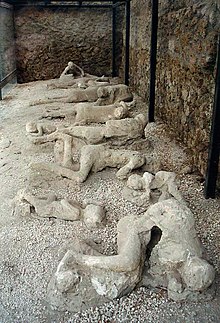
The eruption was cataclysmic for the town. Evidence for the destruction originally came from a surviving letter by Pliny the Younger, who saw the eruption from a distance and described the death of his uncle, Pliny the Elder, an admiral of the Roman fleet, who tried to rescue citizens. The site was lost for about 1500 years until its initial rediscovery in 1599 and broader rediscovery almost 150 years later by Spanish engineer, Rocque Joaquin de Alcubierre in 1748. The objects that lay beneath the city have been well preserved for centuries because of the lack of air and moisture. These artifacts provide an extraordinarily detailed insight into the life of a city during the Pax Romana. During the excavation, plaster was used to fill in the voids between the ash layers that once held human bodies. This allowed one to see the exact position the person was in when he or she died.
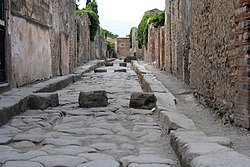
Here is a picture of a paved street in Pompeii. The blocks in the road allowed pedestrians to cross the street without having to step onto the road itself which doubled as Pompeii's drainage and sewage disposal system. The spaces between the blocks allowed horse-drawn carts to pass along the road.

Before leaving Pompeii, we had lunch. Lisa and I had brought stuff we picked up at breakfast (sandwich, fruit, etc) and purchased a drink. Others ate a cafeteria. After eating there was time to shop before boarding our bus for Rome. We followed the Autostrada del Sole speedway across the Roman countryside enroute to the unforgettable and Eternal City of Rome.
Located in the center of the Region of Lazio, Rome is a reflection of every era. The wonders of Rome surround you...a world of art, history and culture that has been attracting visitors since the beginning of the Western civilization.

Our hotel for our stay in Rome was the Best Western President Hotel. Before dinner, several were able to walk to the Basilica of St. John Lateran, the cathedral church of the Diocese of Rome and the official ecclesiastical seat of the Bishop of Rome, who is the Pope.
Dinner was at the hotel. We had leek and potato soup, sliced pork, carrots, and new potatoes. For dessert we had panna cotta with berries.


No comments:
Post a Comment